




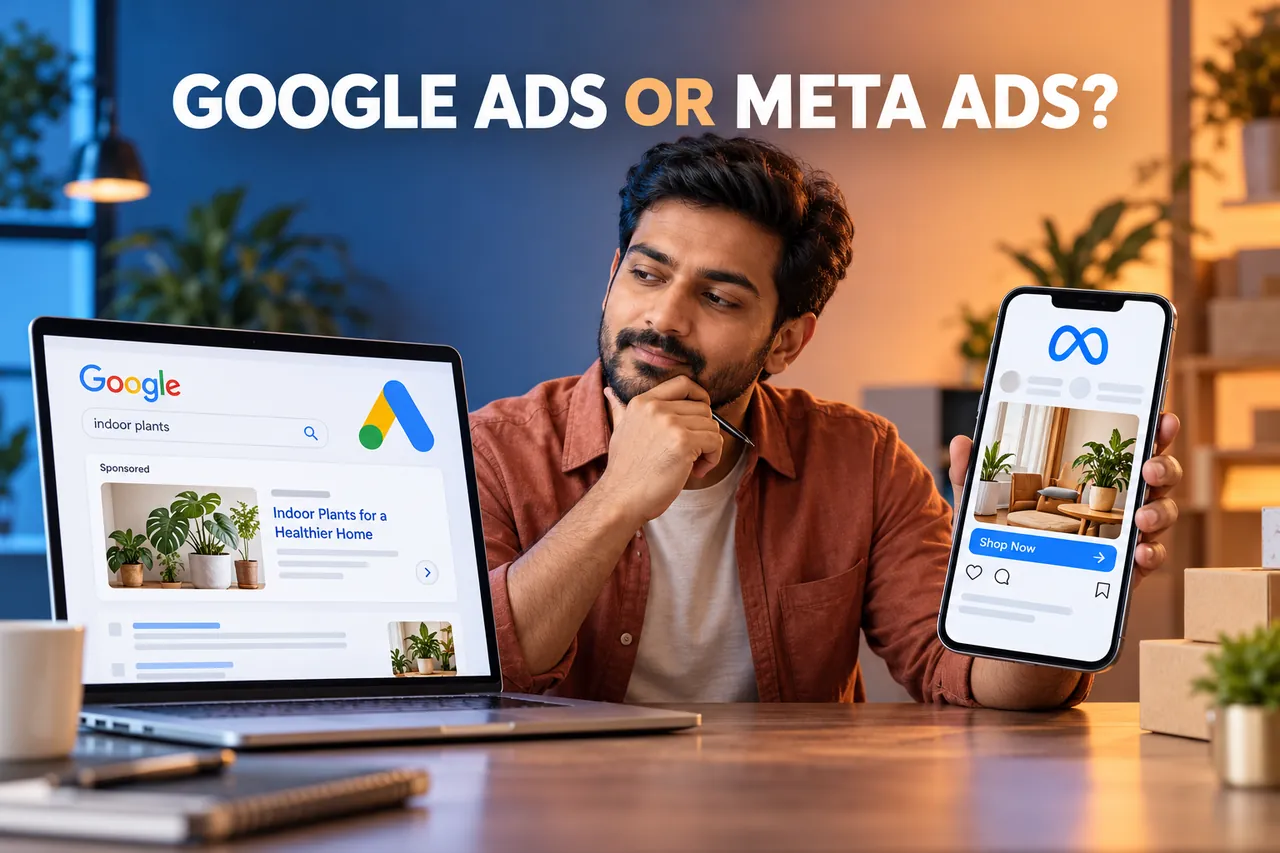
One agency recommends Google Ads because customers are already searching. Another recommends Facebook and Instagram because your products are visual. Both arguments can be relevant, but neither settles the decision without considering your offer, customer journey and ability to measure useful results.
Direct answer: choose the channel around the business goal and the way customers discover and evaluate the offer. Google Search can connect with expressed search intent; Meta can introduce and demonstrate an offer within social experiences. Both ecosystems support more than those simple descriptions, and neither guarantees cheaper customers.
The comparison should end with a testable plan, not a permanent declaration that one platform is always better.
1. Compare the actual campaign types
Google Ads is not only Search. Its campaign-type guidance describes Search, Display, Video and other options. A Google Search campaign and a video campaign can have quite different jobs.
Meta also supports different goals. Its objective guidance describes objectives including awareness, leads and sales. Facebook and Instagram advertising should not automatically be treated as a likes-only activity.
For a useful first comparison, name the proposal precisely: “Google Search for this service” versus “Meta lead generation for this offer.” Comparing an undefined Google campaign with an undefined Meta campaign leaves too much room for misunderstanding.
2. Ask how customers recognise the need
Some customers describe an immediate problem in a search: they need a repair, a particular product or a service provider. Others discover an appealing product, new service or useful explanation while browsing content.
Talk to the business's real customers. What started the buying process? Which questions did they ask? Did they compare suppliers, need a demonstration or discuss the decision with someone else?
These observations help shape the initial channel hypothesis. They do not establish that every search visitor is ready to buy or every social visitor lacks intent. The advertising message and the destination still need to explain the offer clearly.
3. Consider the creative and landing-page requirements
A search-led service campaign needs a relevant message and a page that answers the searcher's question. A social discovery campaign may need stronger visual demonstration before someone understands why the offer matters.
List the creative assets your team can produce honestly: service explanations, product demonstrations, useful comparisons and real operational proof. Do not choose a channel solely because a competitor has an attractive ad.
Review the next step as well. A confusing form, weak mobile page or unavailable product can undermine either channel. Our landing-page service focuses on connecting the campaign promise with the action visitors are asked to take.
4. Use a common definition of a useful result
If Google is judged by qualified appointments and Meta by cheap form submissions, the comparison is unfair. Define a useful enquiry or paid order once and apply the same business definition to both.
Retain the platform's reporting context, but compare it with actual business records. Note duplicates, existing customers, unsuitable locations and cancellations where relevant. Separate a measured platform conversion from an independently confirmed sale.
Do not add both platforms' attributed revenue and assume it equals total store revenue. The same customer may interact with several channels. Your report should explain the difference rather than forcing unrelated totals to match.
5. Compare the full operating cost
Advertising spend is only one part of the plan. Include creative production, landing-page work, tracking, management and the team's ability to handle responses. A channel that needs frequent product demonstrations has a production requirement, not just a media budget.
Avoid universal claims that Meta is always cheaper or Google always produces better leads. A low click cost can still produce an expensive customer if few visitors are suitable or complete the journey.
Agree what you can learn from the available budget and sales cycle. If funds are limited, testing one clear channel hypothesis may be more useful than dividing spend so thinly that neither campaign generates interpretable evidence.
6. Example: urgent services and a discoverable product
Illustrative comparison: an appliance repair company serves a defined area and receives urgent requests. A search campaign for the genuine service is a reasonable hypothesis to investigate, provided coverage, availability and the landing page match.
A homeware brand launching a distinctive product might investigate a demonstration-led Meta campaign, supported by a clear product page and reliable checkout. Customers need to understand the product before deciding whether to buy it.
These examples do not prescribe a platform for every repair business or retailer. They show how the customer situation can produce a channel test. Both businesses may later use complementary campaigns if the evidence supports them.
7. Decide when a combined plan makes sense
A combined plan needs separate roles and shared measurement. One campaign could introduce a product while another addresses active searches. The team should explain what each contributes instead of giving both full credit for every sale.
Document the offer, campaign type, audience hypothesis, destination, success definition and review date. Change the plan when the evidence identifies a useful improvement, not simply because one dashboard looks more impressive.
Digital Country's Google Ads services and social media marketing services can be assessed against the same business brief. For a different comparison, read our existing Google Ads vs SEO guide.
8. Frequently asked questions
Is Google Ads only for people ready to buy?
No. Intent varies by query, campaign type and visitor. Check the actual proposal and the relevance of the traffic rather than relying on the platform name.
Can Meta Ads generate service enquiries?
Meta offers lead-related campaign options. The usefulness of the resulting enquiries depends on the offer, setup, qualification and follow-up.
Should a new business launch on both immediately?
Not necessarily. Consider the budget, creative readiness, measurement and capacity to learn from each channel. A focused first test can be a sensible starting point.
Which platform has the best ROAS?
There is no universal winner. Use comparable definitions and actual business economics. Our ROAS guide explains the calculation and its limits.
9. Official references
Reviewed for this article: Google Ads campaign types and choosing a Meta Ads objective. The channel examples are illustrative business planning scenarios, not claimed performance results.
Choose the channel around the customer journey.
Compare the offer, campaign type, creative requirements and a shared definition of useful enquiries or orders.
Discuss your campaign channels