





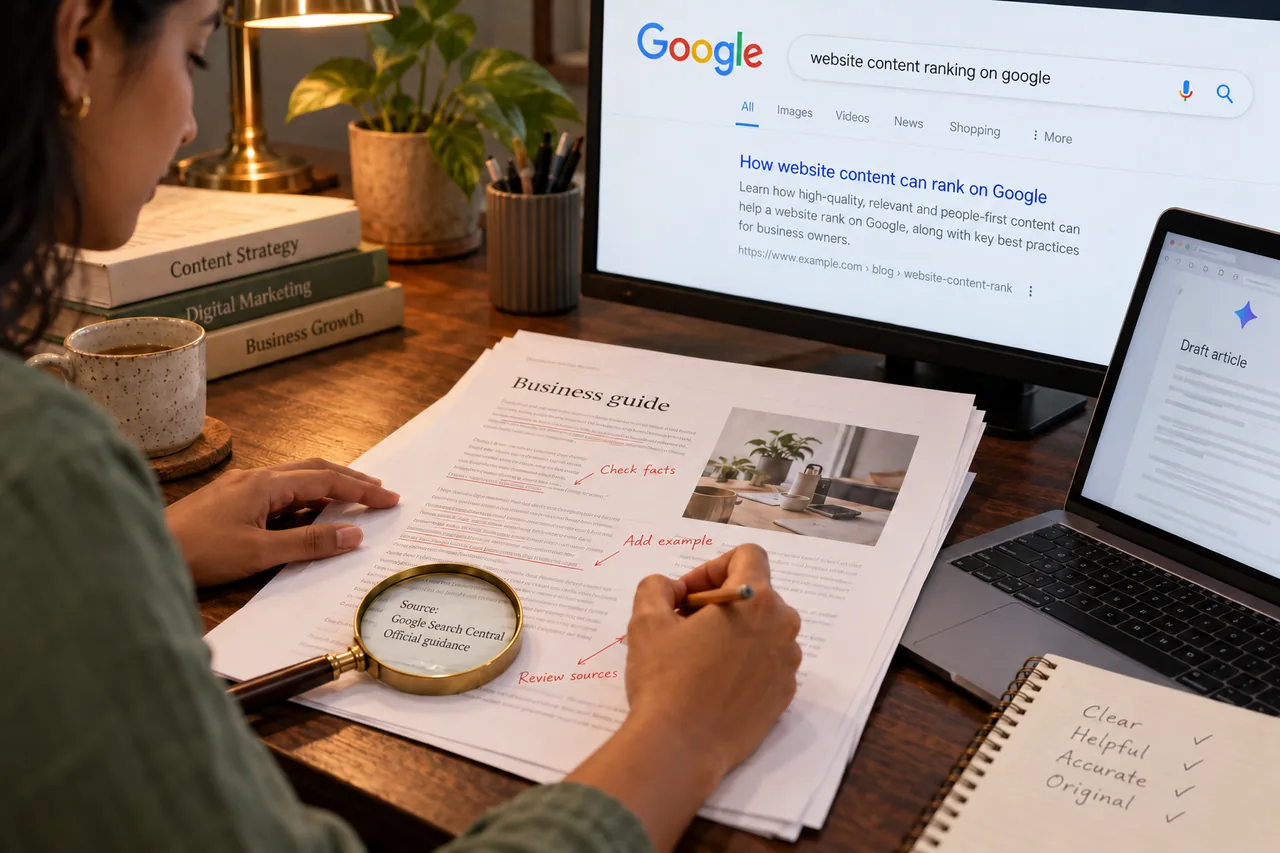
Your team uses AI to draft a service page or an article. The writing sounds fluent, but you are unsure whether publishing it will help the website or create an SEO problem. The useful question is not simply “Was AI involved?” It is whether the finished page answers a real question accurately and adds something worth reading.
AI-assisted content can appear in Google Search. That is different from saying it will be indexed, rank well or generate enquiries. This guide explains how to assess a draft, add original business knowledge and review the published page without treating AI as either a ranking shortcut or an automatic disadvantage.
What does Google's guidance say about AI content?
Google's guidance on generative AI content allows for its use in research and organising original material. It also warns that generating many pages without useful added value can fall under its scaled content abuse policy.
The same guidance stresses checking accuracy and trustworthiness before publication. That review includes the title, description, structured data and image descriptions, not just the visible paragraphs.
For a business, the practical conclusion is to take responsibility for the complete published page. A tool's ability to produce text quickly does not establish that the information is correct or that the page deserves to outrank another useful resource.
What should a useful business article actually solve?
Choose a question your intended customer genuinely needs answered. “How do I prepare product information before building an online store?” creates a clearer editorial job than “Write a long ecommerce SEO article.”
Define what the reader should be able to do afterwards. They might prepare a product spreadsheet, understand a payment integration requirement or decide what information to include in an enquiry. Then include the details needed to reach that outcome.
For example, a preparation guide could explain why product variants need consistent naming and show a fictional size-and-colour example. The value comes from the explanation and usable example, rather than repeating a broad statement that product data is important.
How can you add original value to an AI draft?
Start with information your business can substantiate. That could include an explanation of your process, anonymised patterns in common enquiries, a checklist your team uses or an example you created specifically to demonstrate a decision.
Use genuine project evidence only when you have permission and can support the claim. If you are illustrating a situation instead, label it as hypothetical. Do not present invented results, screenshots, testimonials or customer stories as proof of experience.
Give examples enough context to be useful. Instead of “Improve your website CTA,” explain how a visitor choosing between a quick phone call and a detailed project enquiry might need different next steps. Avoid adding irrelevant locations or service keywords to every paragraph.
Google's people-first content guidance offers questions about originality, completeness and usefulness that can help an editor evaluate the finished page.
A worked example: from generic advice to a useful answer
Consider a draft section that says: “A good contact form improves customer communication and helps your business grow.” It sounds reasonable, but gives a business owner little to act on.
A more useful version could explain a specific review: submit a test enquiry, confirm that the selected service is saved, verify that the team can retrieve the message and separately check email delivery. It could then explain why a stored enquiry and an accepted email are different outcomes.
That example adds a practical distinction and an action a reader can take. It does not need a fabricated client success story or an unsupported percentage improvement.
This editorial process is not an instruction to pad every article. If a short, direct explanation answers the question completely, keep it short. Add detail when the reader needs it to make a decision or complete the task.
What technical checks still matter?
Good writing needs an accessible public page. Confirm that important articles are linked from the website, return the expected response and are not accidentally blocked from indexing. Check the canonical URL, page title and description on the deployed page.
A sitemap can help discovery, while article structured data can describe the content. Neither is a guarantee of indexing or ranking. Schema should match the actual article, including its headline, author or publisher, images and genuine dates.
Use images that explain or support the topic, with appropriate descriptions and efficient delivery. Do not invent a special “AI content schema” or add markup that promises a search position. Google's SEO Starter Guide explains the role of basic discoverability and site organisation.
What should your publishing checklist include?
Before publishing, have someone review the page as a business resource rather than judging whether it merely sounds professional:
- Purpose: is the intended reader's question clear?
- Facts: can names, specifications, claims and product information be checked?
- Examples: are they helpful and honestly described as real or illustrative?
- Original contribution: what does this page add beyond a generic summary?
- Links: do relevant service and related-article links reach the correct destination?
- Presentation: are headings, images and paragraphs comfortable to read on a phone?
- Metadata: do the title, description and structured data describe this specific page?
- Next step: does the reader have a relevant action after their question is answered?
If the draft fails these checks, improve it before publication. Replacing a few words with synonyms does not create a useful new resource, and a plagiarism-tool result does not establish factual quality or search performance.
How should you measure the result after publication?
Check discovery and indexing separately from performance. In Search Console, inspect the relevant URL and then review the queries, impressions and clicks associated with the page as data becomes available. Consider whether those queries match the article's intended purpose.
For the business outcome, look at relevant enquiries or other meaningful actions, not just the number of articles published. A page that attracts unrelated searches may need a clearer scope. A helpful article with weak internal discovery may need a better link from a relevant existing page.
Avoid repeatedly changing publication dates or producing near-identical versions to create the appearance of activity. Update an article when its information or examples need improving, and retain a clear purpose for each URL.
What does Digital Country recommend?
Use AI as part of an accountable editorial workflow: identify a real question, prepare reliable inputs, develop a useful answer, check it and publish it in a technically sound format. Keep the business's actual services and customer needs at the centre of the process.
Our SEO services can help connect article planning, internal links and technical checks. If content is generating visits without useful enquiries, start with why a website can receive traffic but no enquiries rather than assuming that more articles are the only answer.
For the broader operational question, read practical uses of generative AI for small businesses. Different tasks need different levels of verification and integration.
Frequently asked questions
Does Google automatically penalise a page because AI helped write it?
No. AI involvement alone is not the same as a policy violation. The finished content still needs to meet Google's requirements and avoid practices such as producing large amounts of low-value material to manipulate rankings.
Can changing AI text make it guaranteed to rank?
No. Editing can improve a page's usefulness and accuracy, but there is no wording formula that guarantees a position. Evaluate the question being answered, the page's contribution and its technical accessibility.
Do I need a specific word count for an SEO article?
No fixed length makes an article suitable for every query. Use enough detail to answer the reader's question clearly, without adding repetitive sections just to reach a target.
Should I publish a new article if a similar one already exists on my site?
First compare the intended question and answer. If they are substantially the same, improving the existing article may be more useful. Create a separate page when it serves a clearly different need and can provide its own value.
Build content around a real customer question.
Share your services and the questions customers ask so we can discuss an article plan with relevant internal links and technical checks.
Discuss your SEO content plan