





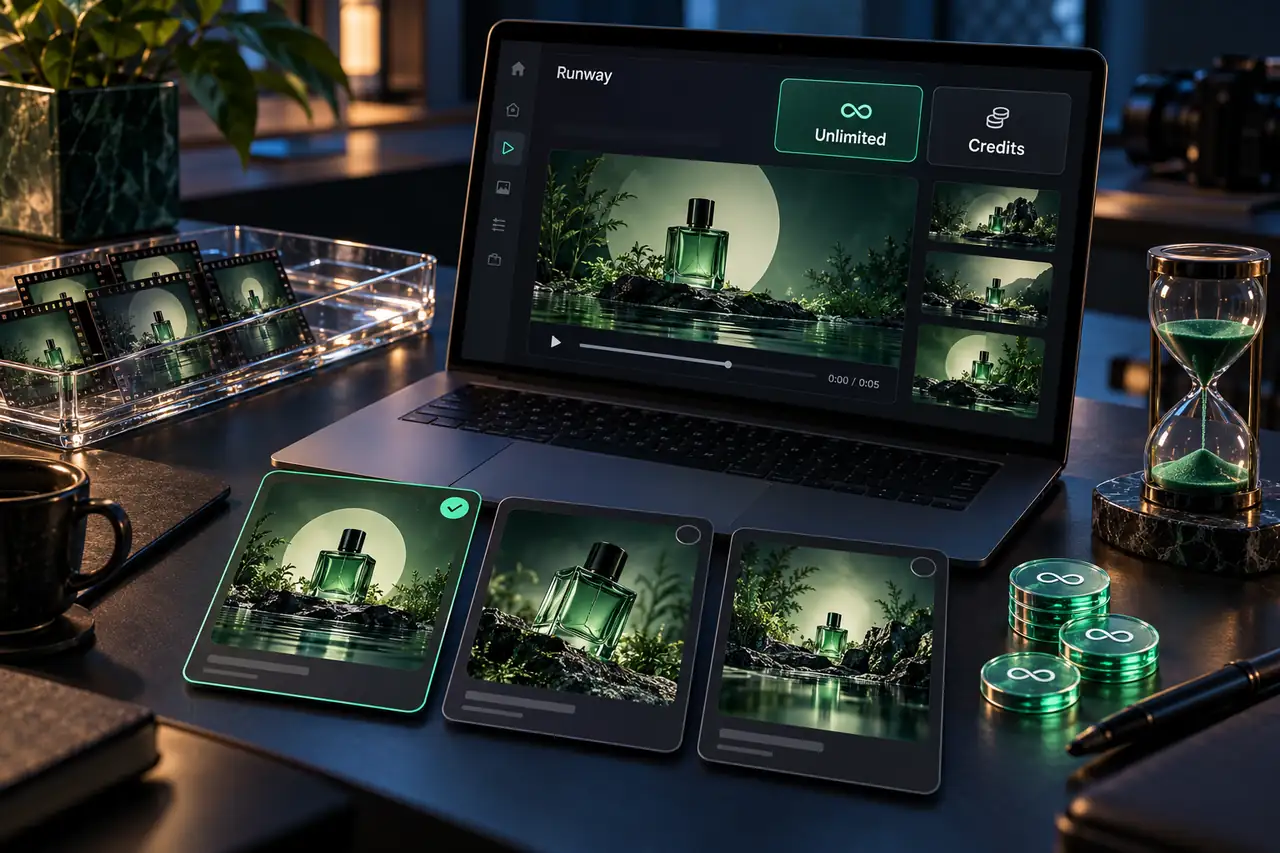
“If the software offers unlimited AI videos, why does each finished video still have a production cost?” The word unlimited can describe genuine access to a generation feature. It does not, by itself, describe a completed business deliverable. To understand a proposal, separate the plan's actual terms from the creative decisions, review and delivery work needed for your project.
What does unlimited AI video access actually mean?
Check the exact feature, model and generation mode covered by the offer. Unlimited access can be real while applying to a defined set of tools. It may also involve a different queue or level of simultaneous activity from a credit-based mode.
For example, Runway's Unlimited Mode guidance describes credit-free generation on supported models, with possible delays and fewer simultaneous generations. Availability depends on the plan and model. Confirm the current account details rather than applying one provider's rules to every tool.
An unlimited offer should be evaluated on what it includes. There is no basis for assuming every such offer is misleading or that it automatically covers every production requirement.
Credits measure tool usage rather than finished quality
Credits are a provider's way of metering certain operations. The amount used may depend on the feature, model, duration or settings. A generation that does not meet the brief may still have used resources, depending on the provider's rules.
Adobe's generative credits FAQ distinguishes standard and premium features and describes access that varies by plan. Check the feature you will actually use, including any offer period, rather than relying on a general subscription label.
The useful production question is how much suitable material results from that access. Ten available outputs and ten approved campaign videos are different quantities. A good result may need very few attempts; another brief may require more exploration.
Separate three parts of the project cost
First, identify the deliverable: the videos, lengths, languages and formats the business needs. Second, identify the generation resources and any other assets required. Third, identify the production services included around those resources.
Production services may cover the brief, concept, script, scene selection, visual corrections, editing, sound, captions, review and final exports. The actual list should match the project. An uncomplicated template video may need a small scope; a detailed animation can need considerably more control.
A transparent quote explains these elements without presenting every software action as expensive manual labour. It also avoids describing a finished service as free merely because some generation is included in a subscription.
An illustrative generation-versus-delivery example
Imagine a business needing one approved product video in landscape and vertical formats. This is an illustrative scenario, not a typical usage benchmark or a real client bill. A producer explores eight generated clips and selects three that fit the concept.
The selected clips still need accurate product graphics, narration, a readable ending and two compositions. If unlimited generation covers the exploration, that can reduce one part of the resource cost. It does not automatically complete those remaining tasks.
Equally, if the first output already satisfies the brief and exports correctly, the producer should not invent extra work. Ask how the actual deliverables and review requirements affect the scope. The number of available generations is useful information, but it is not a complete measure of production effort.
Revisions can affect different parts of a video
A text correction in an editable layer may be quick. A new voice, changed script or recurring product redesign may require more extensive regeneration and editing. The effect depends on how the project was built and the tool being used.
HeyGen's Video Agent FAQ notes that credit usage varies with generated assets and the selected workflow. That is one reason a fixed assumption about every revision can be misleading.
Agree what a revision includes and which decisions should be approved first. A useful production team can explain why a requested change affects the schedule or resources instead of referring vaguely to “AI charges.”
Ask these questions before choosing a plan or proposal
Use the same brief when comparing options and ask for concrete answers:
- Which model and features will the project use?
- Does the current plan cover them in the intended mode?
- Are queue time, simultaneous generation or offer dates relevant?
- Which finished formats and languages are included?
- What review and correction work is part of the scope?
- What files will be handed over for future changes?
If the provider changes an offer, the current account and official terms are the appropriate reference. Avoid building a long-term production estimate around an introductory promotion without checking its duration and coverage.
Reduce waste through better production decisions
Prepare approved references, accurate copy and clear acceptance criteria before generating many variations. Test the hardest requirement with a representative sample. Review speech and recurring visuals before assembling the full project.
Keep useful assets organised so they can be reused where appropriate. A campaign may benefit from an established title system, approved product photographs or a consistent end card instead of regenerating everything for each version.
These steps can improve efficiency regardless of whether generation uses credits or unlimited access. The business is paying for a suitable finished result and agreed service. Increasing the number of attempts without improving that result is not a meaningful objective.
Digital Country's recommendation
Compare proposals using the finished deliverables, production scope and approval process. Ask the team to distinguish software access from the work it will take responsibility for. An honest discussion can include both the efficiency AI creates and the requirements that remain.
Explore our video editing services to discuss a project around your actual assets and intended use. If the proposal involves a longer generated sequence, read about planning short clips into a complete animation. Confirm current plan details when work starts; this article does not quote fixed subscription prices or universal credit rates.
Frequently asked questions
Are unlimited AI video subscriptions always a marketing trick?
No. They can provide genuine unlimited access to supported generation features. Read the scope, mode and current terms so you understand what is included and what needs separate resources.
Does an unlimited plan include unlimited agency revisions?
Not automatically. A software plan governs access to the tool. The agency's agreed scope governs its service, review rounds and deliverables. Ask about both before commissioning work.
Can the agency explain tool costs separately?
Yes. Where those costs materially affect the project, ask for a clear explanation of the estimate or allowance and how extra usage would be handled. A fee need not be calculated solely from credits.
Will buying a higher plan always improve video quality?
No. Access can change the available tools or resources, but the result still depends on the brief, source assets, selected approach and output. Evaluate a representative sample before expanding production.
Compare the finished deliverables behind the quote.
Share your required videos, formats and revision expectations so we can separate tool usage from the production work your project needs.
Discuss video production scope