





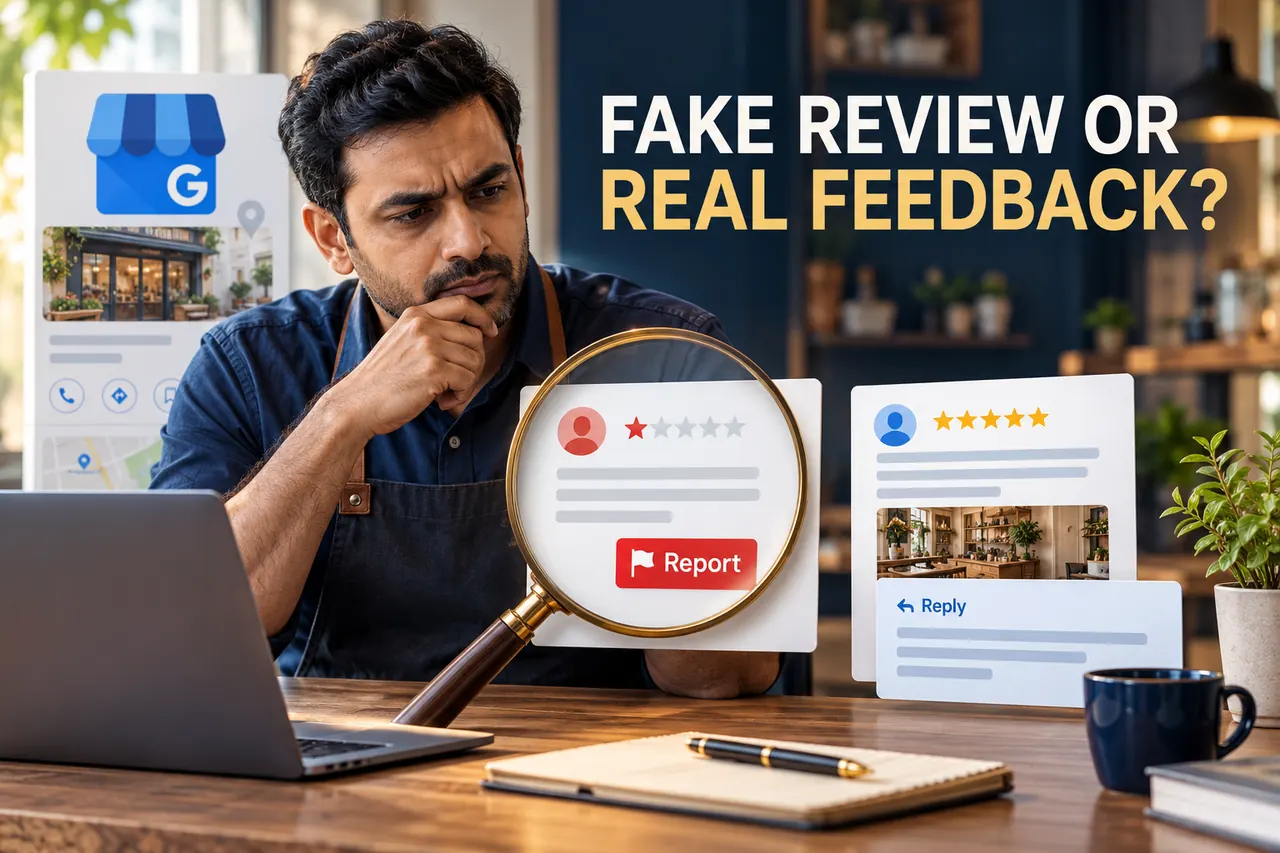
A one-star review arrives, and the owner does not recognise the name. It is tempting to label it fake immediately, ask everyone to report it or promise the customer something in exchange for removal. Those reactions can make a difficult situation harder to handle.
Direct answer: separate a genuine negative experience from content that appears to violate Google's review policies. Respond appropriately to real feedback, document a suspected violation and use the official reporting process. Disliking a review or failing to recognise a public username does not automatically make it removable.
This guide concerns reviews that are visible and troubling. Our existing missing Google review guide covers a different problem: a customer has posted feedback that is not appearing publicly.
1. Preserve the review and check the facts privately
Save the review link, date, text and any relevant context. Check the correct branch and the business records without publishing customer information. A public profile name may differ from the name used for an order or booking.
Ask the team involved whether the experience could relate to a recent enquiry, a visitor or another stage of service. Avoid turning the initial investigation into an accusation against a named person.
Keep the evidence in an appropriate private record. A screenshot can help explain the issue, but it should not become a social-media post exposing contact details or encouraging people to confront the reviewer.
2. Distinguish negative feedback from a policy violation
Google's review reporting guidance states that removal is based on policy violations, not simply disagreement with the review. An unhappy opinion can be genuine even when the business sees the event differently.
Read the relevant Maps content policies. They address matters including fake engagement, conflicts of interest, harassment and inappropriate content. Match the evidence to the actual policy rather than selecting a reason at random.
“We cannot find this name” is a starting point for checking records. It is not conclusive proof of fabrication. The distinction helps the business prepare a factual report and avoid an unrealistic removal promise.
3. Respond to genuine concerns without exposing details
Read the complaint carefully and acknowledge the relevant concern. Keep the public reply calm, short and useful. Offer an appropriate private contact route where the team can investigate the circumstances.
An original example response is: “Thank you for sharing this. Please contact our team privately so we can understand the details and assist.” Adapt it to the actual concern rather than posting the same sentence under every review.
Do not publish order details, medical information, private messages or personal contact data to prove a point. A public reply should show that the business listens without turning the review section into a detailed dispute record.
4. Report a suspected violation through the correct route
If the evidence supports a policy concern, use the reporting option on the review or Google's Reviews Management Tool, as described in its official guide. Select the reason that matches the content and retain the case information.
Check the outcome through the available status process. If Google offers an appeal for an eligible decision, submit a concise explanation and relevant evidence through that route. Do not promise that reporting will cause removal.
Repeated reports from unrelated accounts are not a substitute for evidence. Avoid services claiming that a payment guarantees deletion of any negative review. The platform controls whether the content meets its removal criteria.
5. Handle suspicious patterns carefully
If several reviews arrive together, document the pattern, timing and content without assuming that every review has the same origin. A campaign of abuse requires a clearer record than a general statement that the rating has dropped.
If someone demands payment in connection with negative reviews, preserve the communication and follow the official extortion-reporting route linked in Google's review guidance. Keep sensitive material private.
Do not respond by buying positive reviews, arranging retaliatory reviews or offering a reward for removal. Google's content policy prohibits manipulative review practices. An attempted reputation repair should not create another policy problem.
6. Example: an unrecognised name and a genuine service problem
Illustrative scenario: a repair business receives criticism from a name absent from its booking list. The owner initially assumes the review is fake. A private check finds that a family member posted about a genuine visit booked under another name.
The business investigates the service issue and gives a measured public response. In a separate case involving clearly unrelated promotional spam, it records the content and reports the relevant violation.
These examples illustrate different actions for different evidence. They are not Digital Country client outcomes or proof that Google will remove a particular review after a report.
7. Build a consistent review-handling process
Assign an owner to check feedback, investigate concerns and respond. Define which issues need escalation and where the evidence is stored. Share recurring service problems with the operational team so reviews lead to useful improvements.
Invite honest feedback from genuine customers without incentives or pressure. Do not ask only satisfied customers while diverting unhappy customers away from a public review opportunity.
Digital Country's Local SEO and Google Business Profile services can help organise profile management and an ethical response process. The aim is accurate representation and responsible handling, not manufacturing a perfect rating.
8. Frequently asked questions
Can every one-star review be removed?
No. Google assesses policy violations. A low rating or an opinion the business dislikes is not automatically eligible for removal.
Does an unfamiliar reviewer name prove the review is fake?
No. Check the relevant records and context privately. Public names can differ from the details used in a transaction.
Should I offer a discount if the reviewer deletes the complaint?
Do not exchange incentives for review removal or revision. Resolve a genuine service concern through an appropriate process without manipulating the review.
Can an agency guarantee removal?
No. It can assess the issue and help organise evidence and reporting. It cannot control Google's policy decision.
9. Official references
Reviewed for this article: Google's inappropriate-review reporting process and Maps prohibited and restricted content. Examples and the reply wording are original editorial material. No removal outcome is guaranteed.
Respond to the evidence and the actual concern.
Organise an ethical review process with appropriate replies, private records and policy-based reporting.
Discuss your Business Profile