




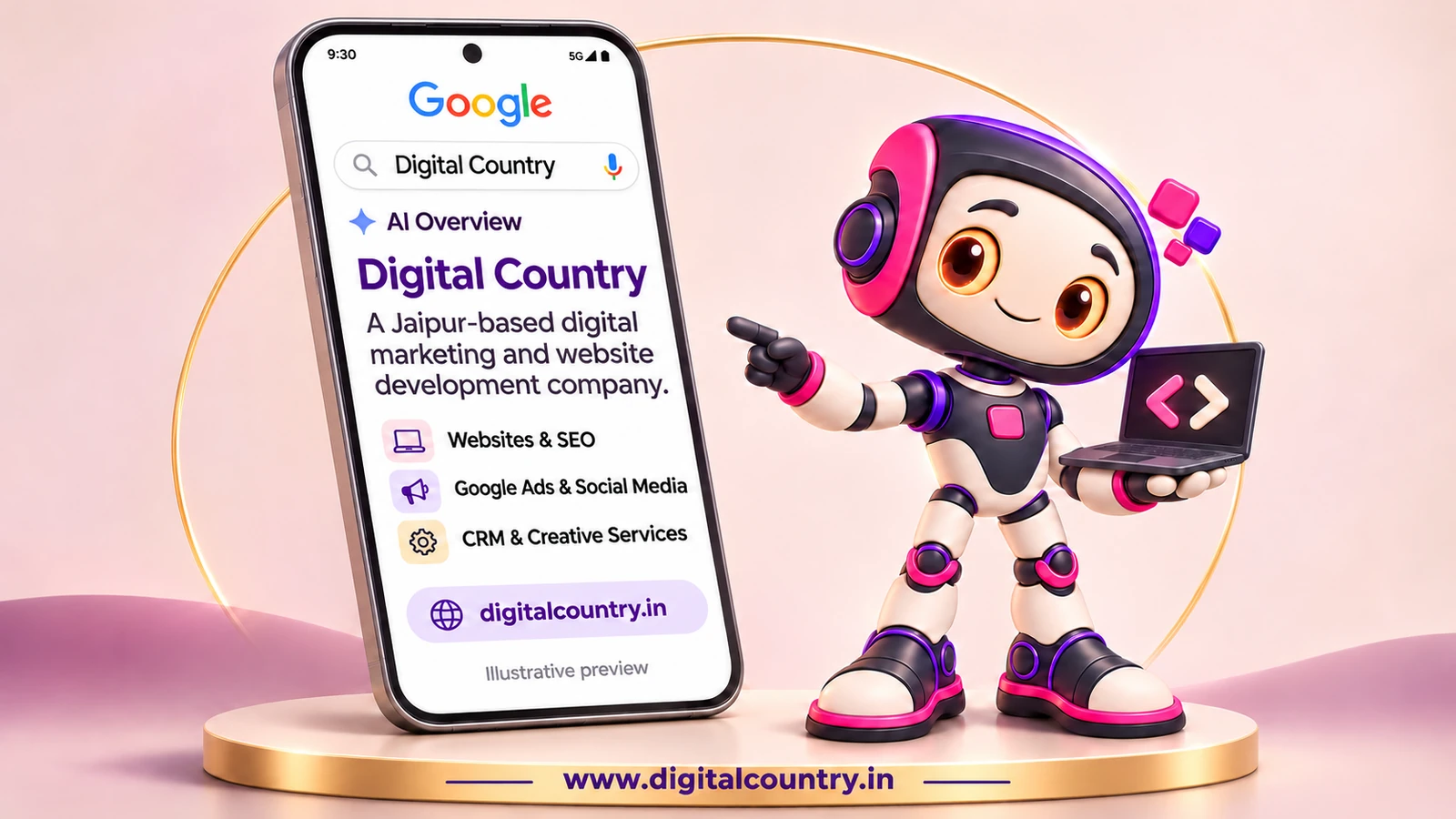
Illustrative Digital Country search preview with DICO. Google interface shown as a branded illustrative preview. Product visual reference.
A customer asks Google a detailed question about a service, and an AI-generated answer appears above some of the familiar results. Can your business website become one of the sources behind that answer?
It can be eligible, but appearing in Google AI Overviews is not something an agency can guarantee. A useful starting point is to make your site accessible, clear and worth referring to. This guide separates Google's published requirements from our practical recommendations for business websites.
Reviewed: 3 November 2026. The cover is a labelled illustrative search preview, not an actual Google result or endorsement. Google documentation linked below supports the platform guidance.
What are Google AI Overviews, and how are they different from ordinary results?
AI Overviews combine an AI-generated explanation with links that let a person explore supporting information. AI Mode supports more detailed questions and follow-up exploration. The layout, wording and sources can change between searches; an AI Overview does not appear for every query.
Think about the customer's decision. “Website developer” is a broad search. “What should a booking website include for a small clinic?” asks for a more complete explanation. A page that genuinely helps answer the second question has a clearer purpose than a page repeating a city and service name.
That is a content-planning example, not a prediction that Google will select a particular page. See Google's guide to AI features and websites.
What does Google require before a page can be a supporting source?
Google says a supporting page must be indexed and eligible to appear in Search with a snippet. There is no separate AI Overview submission form, special AI schema or additional technical qualification that replaces normal SEO. Meeting the requirements does not guarantee inclusion.
For an existing site, begin with a short technical review:
- Can Googlebot access the important page without a login, firewall challenge or unintended block?
- Does the real page return a successful response rather than an error or an unrelated redirect?
- Is the main explanation available as readable text?
- Does an accidental noindex instruction prevent indexing?
- Is the intended page the one Google treats as canonical?
Use Search Console to investigate the exact URL rather than assuming that an attractive page is already indexed. Google's technical requirements are the appropriate reference. If a page has already been crawled but remains missing, our guide to “Crawled—currently not indexed” explains a related diagnosis.
Which customer questions should your business answer first?
Our recommendation is to start with questions the team already answers before a sale. Look at enquiry conversations, proposal discussions and questions from existing customers. Choose a subject where you can explain the real work and the trade-offs.
A Jaipur interior studio might explain what a design consultation includes, what information a homeowner should bring and what happens before a quotation. A manufacturer serving customers across India might explain specification checks, order quantities, sample approval and delivery responsibilities.
These are hypothetical planning examples. They show how local relevance and national usefulness can coexist without adding a list of place names to every paragraph.
Before commissioning an article, write down three things: who needs the answer, what decision they are making, and what first-hand detail your team can contribute. If the brief cannot answer those questions, adding an “AI SEO” label will not improve it.
How can a service page become more useful as a reference?
Review a real service page from the customer's point of view. Does it explain what the service includes, what is excluded, how the work proceeds and what affects the scope? Where appropriate, add original examples, authorised project images and details that help a customer compare proposals.
Google's people-first content guidance encourages original value and clear evidence of who created the information. Our practical approach is to replace unsupported claims with details a reader can assess.
For example, “We build the best websites” says little. A short explanation of how an appointment request reaches the right team member tells a business owner something concrete. A sample launch checklist can show the difference between a page that looks complete and a website whose forms and contact routes have been checked.
Use descriptive headings, a direct opening answer and examples where they help. A table can make genuine choices easier to compare, but copying competitors' FAQs or generating dozens of near-identical pages creates no new business insight.
Do schema, internal links and brand information help?
Structured data should accurately describe what a visitor can see. It is not an instruction forcing Google to recommend a business. Review existing organisation, article and relevant product information for accuracy instead of buying a supposed special “AI ranking schema”.
Our website review also checks whether a customer can move from an article to the relevant service, an example of the work and a useful contact option. A helpful explanation that cannot be found through the site's navigation is difficult for people to discover too.
Keep the business identity understandable: the same real name, working contact details, clear service descriptions and accurate profile information. For a local business, a well-maintained Google Business Profile supports customers looking for that business; it is not a guaranteed AI Overview placement mechanism.
The SEO Starter Guide explains the broader foundations. Connect them to the actual customer journey rather than treating a technical checklist as the entire marketing plan.
How should you measure progress without confusing mentions with leads?
Separate three outcomes in your reporting: search visibility, visits to the website and useful customer enquiries. A source mention is an observation, not proof of revenue.
Choose a small set of real customer questions and record the date, language, location context and result you observed. Occasional manual checks are useful for understanding presentation, but they are not a complete market-share report. A result seen on one device should not be described as a permanent position for every customer.
Google includes AI-feature activity in the overall Web reporting in Search Console; it does not offer a dedicated AI Overview performance filter in the guidance reviewed for this article. Review that data alongside your enquiry records and analytics. Do not label all organic leads as “AI leads” simply because an AI Overview appeared during a check.
Our recommended report records the page improved, the question it addresses, the work completed, the observed changes and the next decision. Compare qualified enquiries as well as visits. If the website attracts attention but no business, review the enquiry journey too.
What is a sensible first-month action plan?
Use the first month to establish a reliable baseline and improve a small amount of important content.
- Week one: confirm the priority pages, inspect indexing and collect customer questions. Fix access problems before producing more pages.
- Week two: improve one service page and one genuinely useful explanatory article. Add original business detail and appropriate sources.
- Week three: check internal links, mobile readability, images and the contact journey. Confirm that enquiries reach the team.
- Week four: review what changed in visibility, visits and enquiries. Decide what to improve next.
This is Digital Country's suggested working plan, not Google's timetable or a promise of results in 30 days. The same work should make the website more useful even when a particular query does not show an AI Overview.
For business owners comparing support, ask an agency to explain the specific content and technical work it will do, what it will measure and which outcomes it cannot control. Our guide to choosing a digital marketing company offers a related checklist.
Frequently asked questions
Can I pay Google to include my website in an organic AI Overview?
There is no paid submission process that guarantees your page becomes an organic supporting source. Advertising and organic selection are different arrangements.
Is AI SEO different from normal SEO?
“AI SEO” is often used as a service label. Ask what work it describes. Google's published approach still relies on the normal Search foundations, useful content and eligibility requirements.
Do I need to publish AI-generated articles every day?
Set a schedule your team can support with accurate, useful information. More articles alone do not establish expertise. Our article on AI-generated content and Google rankings explores that separate question.
Can a small business compete with larger websites?
A small business can publish a focused, useful answer based on its actual work. There is no guarantee that Google will choose it. Prioritise questions you can answer well rather than trying to imitate a large publisher's entire content catalogue.
Will Google AI Overviews SEO also guarantee a ChatGPT mention?
No. These are different products and selection systems. A claim of guaranteed visibility across all AI assistants needs careful scrutiny.
Official references and image credits
This guide distinguishes Google's published guidance from Digital Country's own examples and working recommendations. Reviewed on 3 November 2026.
- Google: AI features and your website
- Google Search technical requirements
- Google: creating helpful, reliable content
- Google SEO Starter Guide
The cover is an illustrative Digital Country search preview, not an actual Google result. DICO is Digital Country's official mascot. Product names and screenshots identify the services discussed; the article does not imply an endorsement.
Build search visibility around useful answers.
Share your website and the questions your customers ask. Our Jaipur-based team can review the content, technical foundations and enquiry journey for your business.
Discuss your website and SEO