




Your reach falls, and someone says the account has been shadowbanned. That word is used for many different symptoms: lower views, content that is not recommended, a removed post or a feature that no longer works. They should not be treated as one confirmed diagnosis.
Direct answer: inspect the actual notices in Instagram's Account Status and separate recommendation eligibility from ordinary content performance. Follow the action available for the specific issue. A reach dip by itself does not prove that the account is restricted, and an eligible account is not guaranteed recommendation.
This guide focuses on status and distribution restrictions. For content that is being shown but receives little response, read the separate low Instagram engagement guide.
1. Record the specific change
Write down what changed, when it began and which content is affected. Is the issue limited to one reel, the whole profile, recommendations to non-followers or a feature such as posting or messaging?
Keep the relevant screenshots and compare equivalent periods. A large result from one unusually successful post is not automatically a fair baseline for every later post.
Check whether the account displays a notice. A measurable decline and a documented restriction can exist together, but one should not be assumed from the other. That distinction determines whether you need a content review, a technical report or a policy-response process.
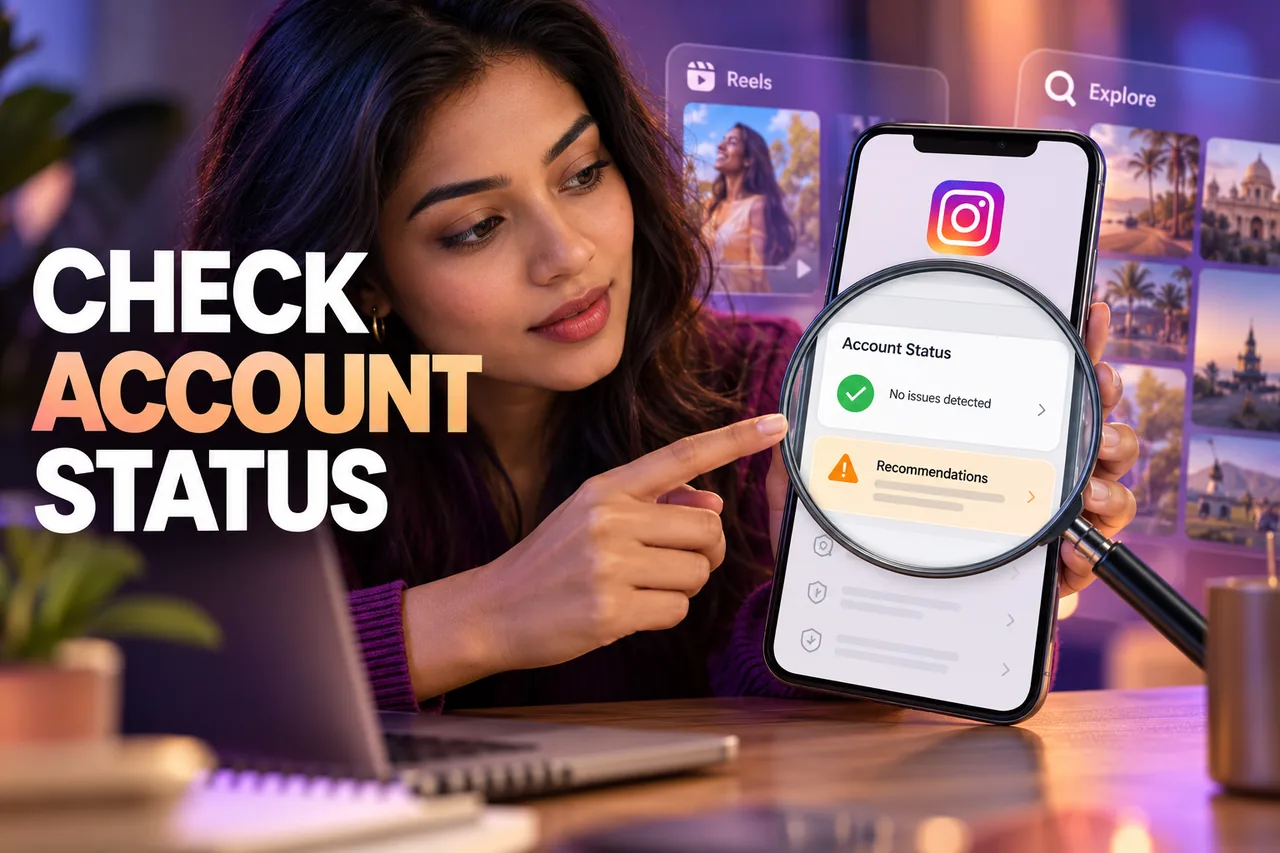
2. Open the actual Account Status information
Use Instagram's current Account Status controls for the account you manage. Its official guide explains that the area can show removed content, features that cannot be used and relevant review options.
Read the exact message and the affected item. Interface routes can change between app versions and devices, so follow the options actually shown rather than repeatedly searching for an old menu screenshot.
Do not enter credentials into an unofficial “shadowban checker.” Keep recovery codes and sensitive account information private. The authorised account's own status information is the appropriate starting point for a restriction claim.
3. Understand recommendation eligibility
Instagram's recommendation eligibility guidance distinguishes content being recommended to non-followers from content appearing to followers. For professional accounts, relevant eligibility information can be available in Account Status.
The guide also explains that eligibility does not guarantee a recommendation. A healthy eligibility status is not a promise of a particular reach figure.
If an item or profile element is flagged, inspect the identified issue and the applicable guidance. Do not assume that changing a random hashtag addresses a concern involving the content, profile photo or bio. Match the action to the notice.
4. Use the relevant correction or review option
Where Instagram offers editing, removal or a review request for the issue, read the instructions before acting. Preserve a private record of the item and decision so the team understands what was changed.
If you believe the decision is incorrect, use the official review route available for that notice. Explain the relevant facts without paying someone who claims a guaranteed private unlock process.
Do not delete the entire content history or create a replacement account solely to bypass enforcement. A targeted response is easier to understand and document. Review availability and outcome remain subject to the platform's process.
5. If no restriction appears, investigate performance
Check distribution and content response using the metrics available in your account. Review the topic, format, audience fit and recent changes. Separate a post that was rarely shown from one that was viewed but did not hold attention.
Also investigate reproducible technical problems through the appropriate support route. Record the device, app version and affected action if a feature fails without an explanatory notice.
Avoid “reset” rituals based on a fixed number of days, a supposedly perfect hashtag list or mass follow-and-unfollow activity. They do not establish what caused the issue. A clear record supports a more useful decision than repeated unrelated changes.
6. Example: low non-follower distribution with a clear notice
Illustrative scenario: a retail account notices that new-customer discovery has weakened. In Account Status, the manager finds an eligibility notice identifying a profile element. The team reviews the actual guideline and uses the correction or review option offered.
It then checks the status again and evaluates subsequent content performance separately. It does not assume that removing a notice guarantees the next reel will reach a large audience.
This example describes a diagnostic sequence. It is not a client case, a fixed recovery timetable or a claim that all drops in non-follower views have the same cause.
7. Keep account and content responsibilities connected
Assign an authorised owner to review notices and permissions. Keep a record of content approvals, relevant policy decisions and support outcomes. The content team should know which issue is being addressed and which changes are unrelated.
Continue to plan useful content for the genuine audience. Account eligibility, content response and customer conversion are three different review questions, each with its own evidence.
Digital Country's social media marketing services can help organise that review. An agency can assess the information and improve the process; it cannot guarantee Instagram's recommendation or review decision.
8. Frequently asked questions
Does a drop in reach prove a shadowban?
No. Inspect the actual notices and performance evidence. “Shadowban” is too broad to replace a specific diagnosis.
Does eligible mean Instagram must recommend my content?
No. Instagram's guidance explicitly distinguishes eligibility from a guarantee that recommendations will occur.
Can content still reach followers if it is not eligible for recommendations?
Instagram's guidance says the recommendation rules concern public-account recommendations to non-followers. Read the specific account notice for the issue you face.
Can an agency guarantee recovery in a fixed number of days?
No. Correction and review depend on the actual issue and platform process. Avoid fixed-timetable promises without a basis in your case.
9. Official references
Reviewed for this article: Instagram Account Status and recommendation eligibility. Menu labels and available actions may vary. The example is illustrative and no reach or recovery outcome is guaranteed.
Start with the actual account notice.
Separate restriction evidence from content performance and follow the appropriate correction or review process.
Discuss your social account review