





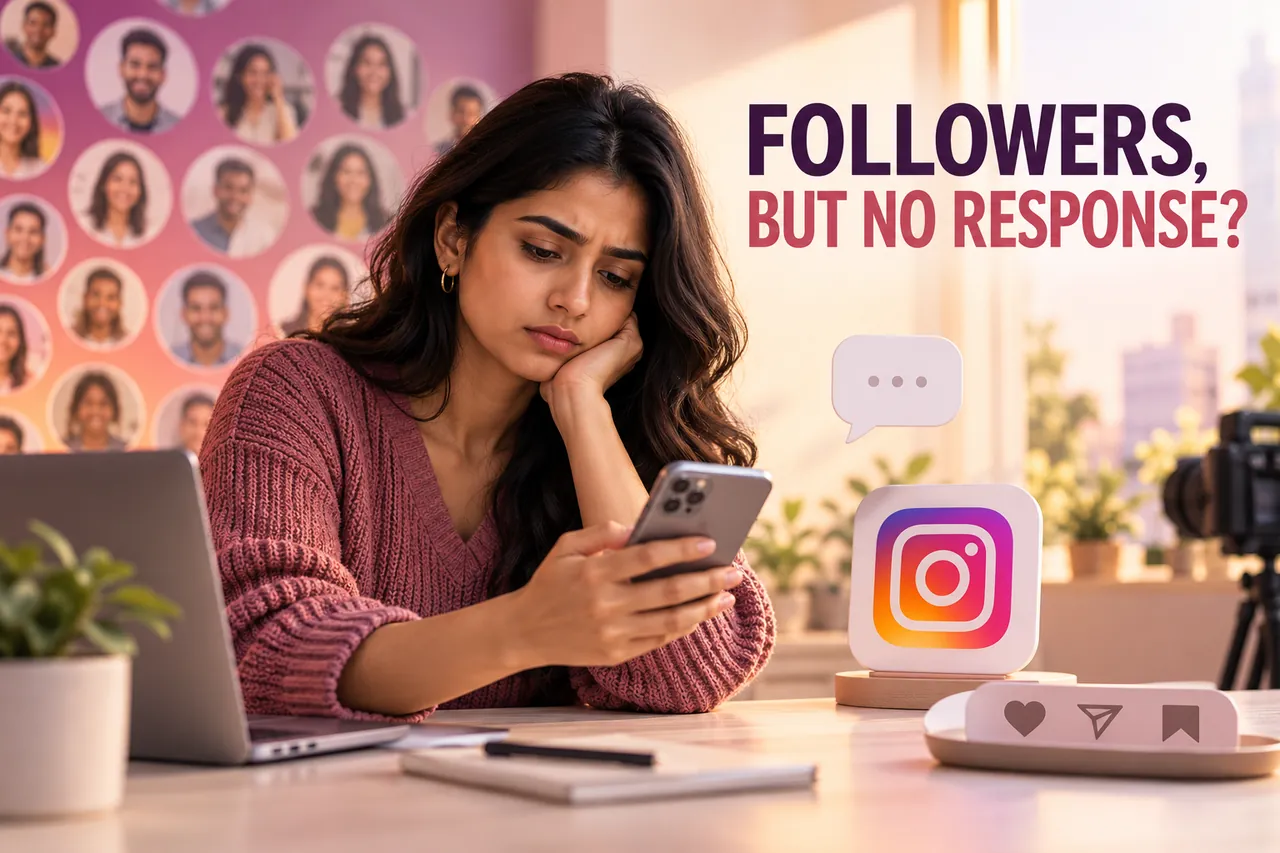
The account has followers, yet recent posts receive little response. Before concluding that the account is restricted, examine who sees the content and what those people are being asked to do. A follower total does not show how many suitable people saw a particular post.
Direct answer: check distribution, audience fit and the usefulness of the content separately. Compare similar posts with consistent measures, then test a clear improvement. Low likes alone do not prove a shadowban, and posting more of the same material is not a complete diagnosis.
This guide concerns organic content response. If the account displays a recommendation or feature restriction, use the separate Instagram reach and Account Status guide.
1. Define what “zero engagement” actually means
Check whether the concern is low views, few comments, limited saves or no meaningful messages. Those are related but different observations. Record the period and the content being compared.
Instagram's Insights guide explains available account and content measures and their definitions. Use the information shown for your account rather than an old screenshot with different labels.
Avoid combining every measure into an unexplained score. If you calculate an engagement rate, state the numerator and denominator. Interactions divided by followers and interactions divided by viewers do not describe the same thing, and several actions can come from one person.
2. Check how the audience was built
Review the account's history. Were followers attracted by the business's actual subject, an unrelated giveaway, a previous brand identity or content aimed at a different audience? A large but mismatched audience can make current posts difficult to assess.
Look for patterns in the information available, including relevant locations and the topics that prompted useful conversations. Do not publicly accuse individual followers of being fake because they did not interact with a post.
Avoid buying followers or joining artificial engagement schemes to repair the ratio. The business needs a relevant audience and useful content, not a larger number disconnected from customer interest.
3. Ask whether each post answers a real question
A feed made entirely of generic greetings and sales posters may give a suitable customer little to discuss or save. Collect questions from enquiries, sales calls and service delivery, then plan content around them.
For a product, demonstrate how it is used and explain a meaningful detail. For a service, show the process and answer a common uncertainty with authorised, genuine material. Do not invent client results to create an impressive post.
The opening message should make the subject understandable without forcing the reader to decode a slogan. Use a clear reason to continue watching or reading that matches what the content actually delivers.
4. Review the format and viewing experience
Check whether text is readable on a phone, the product is visible and the audio or captions communicate the intended meaning. A useful idea can be lost in a rushed video or a crowded image.
Compare like with like where possible: similar subjects, formats and review periods. One short video and one detailed carousel may serve different tasks. Instagram's ranking explanation describes different ranking systems across its surfaces, rather than one universal formula.
Treat format experiments as questions to investigate. There is no guaranteed content format, posting hour or hashtag count that will make every business's followers respond.
5. Make the requested response natural
Ask for an action that fits the information. A practical checklist may be useful to save; a service explanation may prompt a specific question; a product demonstration may lead to a profile visit.
Avoid asking for unrelated comments purely to create activity. The response should help the audience or the business understand something useful. Reply to genuine questions and use recurring ones to improve future content.
Do not assume a quiet comment section means nobody found the content useful. Review the relevant signals together, including the quality of actual conversations where those can be recorded appropriately.
6. Example: followers attracted by an unrelated giveaway
Illustrative scenario: a home-decor business grows its account through a broad prize giveaway. Later, detailed product posts receive little response from that audience. The owner initially blames every creative design.
A review examines the audience source and identifies the subjects that attract relevant product questions. The team plans demonstrations, answers practical buying questions and evaluates the responses rather than repeating the giveaway to increase the follower total again.
This is a diagnostic example, not a client success story or a promise that a particular content series will restore engagement. It shows why audience history belongs in the investigation.
7. Build a small, reviewable content test
Choose a few real audience questions and agree the purpose of each post. Record the format, opening message, distribution context and intended response. Review comparable results and note what the audience actually asked.
Use findings to improve the next content plan. Keep distribution restrictions separate from creative performance, and engagement separate from sales. Our followers-to-customers guide examines the later commercial journey.
Digital Country's social media marketing services and short-form content services can connect the content plan with genuine audience questions and an understandable review process.
8. Frequently asked questions
Do many followers guarantee views on every post?
No. The follower count and the audience that sees an individual item are different measures. Review the relevant content insights.
Should I assume low likes mean a shadowban?
No. Check the actual account status and content evidence. Low response can have several non-restriction causes.
Is posting every day the universal solution?
No. Review relevance, quality, audience and the production capacity to maintain useful content. Frequency alone does not answer those questions.
Which engagement benchmark should every business use?
There is no useful single benchmark for all formats and audiences. Define the calculation and compare relevant content with clear context.
9. Official references
Reviewed for this article: Instagram Insights and Instagram ranking explained. The ranking article is a platform explanation originally published in 2023, not a claim that every weighting remains unchanged in 2026. The diagnostic examples are original editorial material.
Plan content around questions your audience actually asks.
Compare relevant posts, define their purpose and review meaningful responses alongside distribution.
Discuss your content plan