





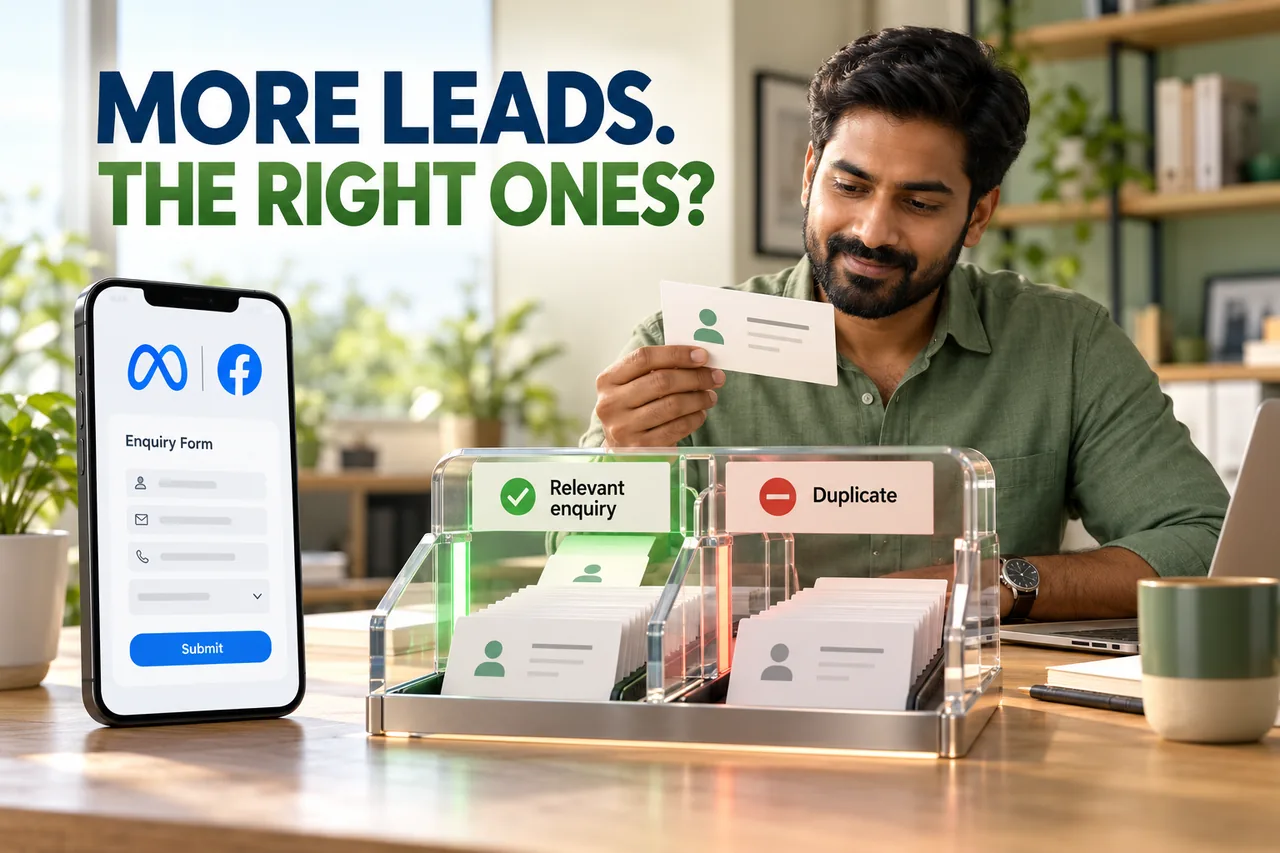
The campaign reports enquiries, but the team finds duplicate requests, unsuitable requirements or people who do not answer. Calling all of them fake hides several different problems. The business needs to know which part of the offer, form, delivery or follow-up is failing.
Direct answer: classify the lead problem before changing the campaign. Review the original ad, relevant qualification, receiving records and actual contact outcomes. Judge improvements by suitable conversations and later business stages, not by the largest possible form count.
This article focuses on lead suitability. Our cost-per-lead guide covers the related but separate question of acquisition efficiency.
1. Give different problems different labels
Separate duplicate submissions, out-of-coverage requests, wrong-service requests, incorrect contact details and people who have not yet responded. A person missing one call is not proof of a fabricated enquiry.
Define what qualifies for this business. Use relevant criteria such as the requested service, genuine coverage and the next action the person wants. Do not invent a qualification rule after seeing the campaign result solely to make the report look better.
Keep the evidence private and proportionate. The purpose of classification is to improve the process, not to publish customer details or accuse individuals of wrongdoing without a basis.
2. Re-read the promise that generated the request
Ask what a reasonable person would understand from the advertisement. A free-resource offer, a broad discount or a vague service claim can attract people with expectations different from the sales team's.
State the real service and important conditions clearly before submission. If an estimate depends on scope, explain that rather than suggesting a universal price. If coverage is limited, make the genuine boundary understandable.
Compare recurring lead mismatches with the ad that produced them. A wrong expectation may be a message problem, not evidence that the entire platform sends bad leads. Correct the specific promise before making unrelated audience changes.
3. Add relevant, proportionate qualification
Ask for information the business needs to handle the initial request. A service choice or a genuine coverage question can be useful; a long interrogation can discourage suitable people without reliably stopping misuse.
Review the form options currently available for the account and test the experience before publishing. Where a confirmation or review step is offered, assess whether it helps the person understand what they are submitting.
Avoid asking for unnecessary sensitive information. Keep the privacy explanation clear and use the data only through an appropriate business process. A lead form should not become an excuse to collect details unrelated to the stated enquiry.
4. Check duplicates and delivery before blaming the audience
Compare the original submission with the record the business receives. An integration retry or repeated import can make one request appear as several leads. The team should know which reference identifies the original request.
Check that service choices and other relevant answers reach the person responding. If staff see only a name and phone number, they may miss the context needed for a useful conversation.
Keep unique requests, contact attempts and qualified prospects separate in the report. A delivery or record-handling defect requires a technical repair; it should not be presented as an audience failure.
5. Review the contact process fairly
Assign ownership of incoming requests and record the actual attempt outcome. Use the person's stated contact preference where appropriate and avoid repeated intrusive outreach.
Check whether the first response identifies the business and the request clearly. Someone who submitted several enquiries may not immediately recognise an unexplained call. Staff should understand the offer and the answers already provided.
Distinguish not yet contacted, unreachable after the agreed process, unsuitable and genuinely disputed submission. These labels help identify operational problems without pretending that every unresolved request is either a guaranteed sale or a fake identity.
6. Example: a service choice lost during handover
Illustrative scenario: an installation company collects a relevant service selection in its lead form. Its internal notification forwards only the name and number. Staff use a generic sales script and misunderstand several requests.
The team traces the handover, restores the relevant context in the approved receiving process and reviews the actual service fit. It then tests any further qualification change against completion and suitable conversations.
This is an illustrative diagnosis, not a claimed client result. It shows why lead quality depends on the information reaching the business as well as the advertisement that generated the request.
7. Feed useful outcomes into the next review
Maintain an agreed record of unique requests and meaningful later stages. Review recurring reasons for mismatch and test one relevant change at a time: the offer, coverage explanation, question or receiving process.
If considering a CRM-to-platform integration, review Meta's Conversions API guidance with the responsible technical team. An integration needs an appropriate data and privacy design; it is not a guarantee that every enquiry becomes genuine or suitable.
Digital Country's lead generation services and custom CRM development can be scoped around the actual handover and qualification requirements. Start with a clear record of the problem and the information the responding team needs.
8. Frequently asked questions
Does an unanswered call mean the lead is fake?
No. Review the agreed contact process and available evidence. Unreachable, unsuitable, duplicate and fabricated are different descriptions.
Should I ask many questions to block poor-quality leads?
Use proportionate questions that help handle the real request. More fields can reduce completion without necessarily solving the underlying mismatch.
Should the campaign be judged only by raw CPL?
No. Compare the cost and number of suitable conversations and later outcomes as well. Keep the qualification definition consistent.
Can a CRM integration guarantee better lead quality?
No. It can support record handling and relevant measurement when implemented appropriately. The offer, consent, data quality and response process still matter.
9. Official reference
Technical reference: Meta Conversions API overview. The classification and handover checklist are original editorial guidance. Follow current platform requirements and the business's appropriate privacy process; no perfect-quality or customer-conversion guarantee is offered.
Connect each request with the context staff need.
Review the promise, qualification questions, unique record and response process before judging lead quality.
Discuss your lead handover