





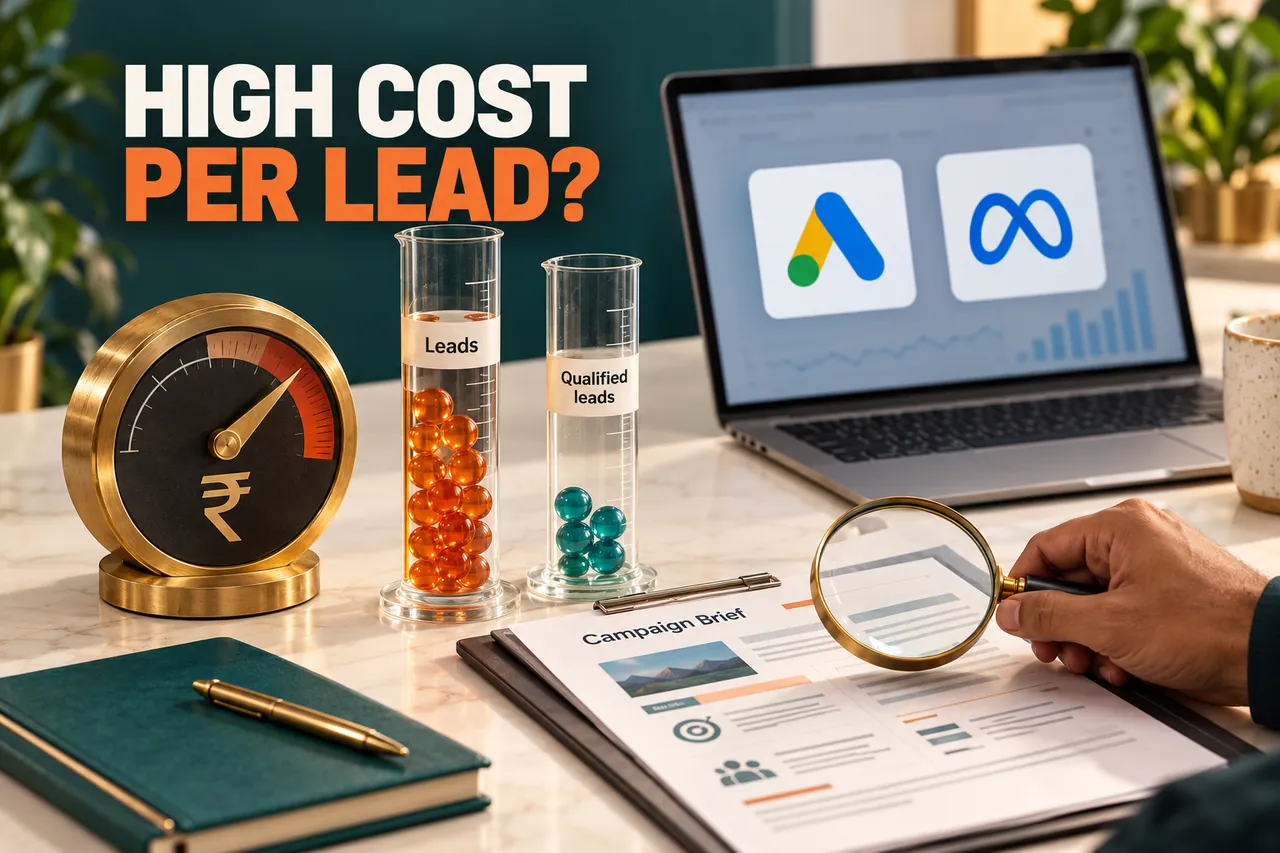
The campaign is producing enquiries, but each one feels expensive. Before reducing the budget or demanding cheaper clicks, define the cost and the lead being counted. A campaign with a low raw lead cost can still be poor value when few requests are relevant.
Direct answer: verify measurement, calculate raw and qualified lead costs separately, then examine traffic cost, enquiry completion and customer suitability. Improve the stage that actually limits the result. There is no universal ideal CPL for every industry, city or service.
This guide focuses on acquisition efficiency. If the main issue is fake, duplicate or unsuitable submissions, use the separate Meta lead-quality guide.
1. Define the numerator and denominator
For a clearly stated advertising-only measure, cost per lead = advertising spend ÷ counted leads. State the period, sources and whether the count represents unique submitted requests, conversations or qualified prospects.
If the report includes agency or production costs, label that broader cost separately. Do not compare it with another report that includes only media spend and call the difference campaign inefficiency.
Record duplicate handling and qualification rules. A changing definition can make CPL appear to improve without producing a better business outcome. The owner and campaign team need to agree the calculation before setting a target.
2. Compare raw and qualified lead cost
Illustrative calculation: ₹2,000 in advertising spend produces five unique requests. The raw CPL is ₹400. If two requests meet the agreed qualification criteria, the cost per qualified lead is ₹1,000.
These are hypothetical numbers, not market rates or Digital Country results. They demonstrate how the same spend produces different useful measures depending on the denominator.
A business should not reduce the apparent cost by counting every click as a lead or dropping qualification from the report. Keep suitable enquiries visible and investigate why unsuitable requests occur. Cheap volume is not automatically cheap customer acquisition.
3. Verify the recorded action
Check that the conversion is tied to the intended completed action. A submit-button click can happen before validation fails, while a successful enquiry can be missed if the trigger waits for a page that is no longer used.
Compare a sample of actual requests with the measurement and the report period. Review attribution and reporting differences rather than expecting unrelated systems to produce identical totals.
For a Google Ads implementation, our conversion tracking diagnosis provides the specific checks. Meta's objective guidance also makes clear why the selected goal and action location need to match the business task.
4. Identify whether visits are costly or completion is weak
Separate the price of attracting a relevant visitor from the proportion who complete an enquiry. Expensive traffic and a poor enquiry journey are different problems, even though both can increase CPL.
Review search relevance or the audience hypothesis, creative, placement context and the destination. A misleading message may attract inexpensive clicks that do not fit the service. A clear ad can still lose suitable people on an unhelpful page.
Use comparable groups and sufficient relevant activity to interpret the result. One expensive request does not establish a stable pattern, and one unusually cheap request does not prove that the target has been solved.
5. Improve the offer and enquiry experience
Explain the actual service, important conditions and what happens after submission. Remove unnecessary uncertainty before asking for personal details. Use genuine proof and a next step that fits the customer's decision.
Test the form or conversation route on a phone. Check input errors, receiving records and the staff response process. A broken or unattended enquiry journey can make an acquisition campaign less useful regardless of its click cost.
Do not remove every qualification question solely to lower raw CPL. Review completion and suitability together. A shorter form can produce a different mix of requests, which should be assessed rather than automatically called an improvement.
6. Example: a cheaper form count with worse suitability
Illustrative scenario: a specialist service removes the question that distinguishes its actual offering from a commonly confused service. More people submit, and raw CPL falls, but the sales team rejects a larger share of requests.
The next review restores a clear service explanation and tests a proportionate qualification step. The team compares qualified enquiries and later outcomes rather than celebrating the lower raw figure alone.
This example does not prove that extra fields always improve lead quality. It shows why an efficiency decision needs both the cost calculation and the business's suitability record.
7. Run a controlled improvement cycle
Choose a specific hypothesis: clearer coverage, a better service explanation, a more useful creative or a repair to the enquiry journey. Record the change and the metric it is intended to improve.
Review raw CPL, qualified CPL and actual sales-stage outcomes where available. Include operational factors such as response capacity and availability. Avoid cutting every campaign that has a higher raw CPL if it consistently produces more suitable opportunities.
Digital Country's Google Ads services and lead generation services can be evaluated against those definitions. Start with a verified baseline and a useful business target rather than a universal cheap-lead promise.
8. Frequently asked questions
What is a good CPL for every business in India?
There is no single useful number. The service, audience, qualification, economics and sales process need to be considered.
Will a lower click cost always reduce qualified lead cost?
No. The new visitors may complete less often or be less suitable. Review the full journey and the agreed qualification measure.
Should I remove questions to make leads cheaper?
Test proportionate changes and compare suitability as well as completion. Do not judge the result only by raw volume.
Does high CPL prove the agency is doing poor work?
It requires investigation. Review definitions, implementation, market context and the actual changes being tested rather than inferring quality from one unexplained number.
9. Reference and calculation note
Platform reference: Meta objective and performance-goal guidance. The CPL arithmetic and examples are original, explicitly hypothetical teaching examples. They are not current market prices, forecasts or guaranteed campaign outcomes.
Use a cost measure that reflects suitable enquiries.
Verify the lead definition and baseline, then test a specific change in relevance or completion.
Review your lead-generation efficiency